
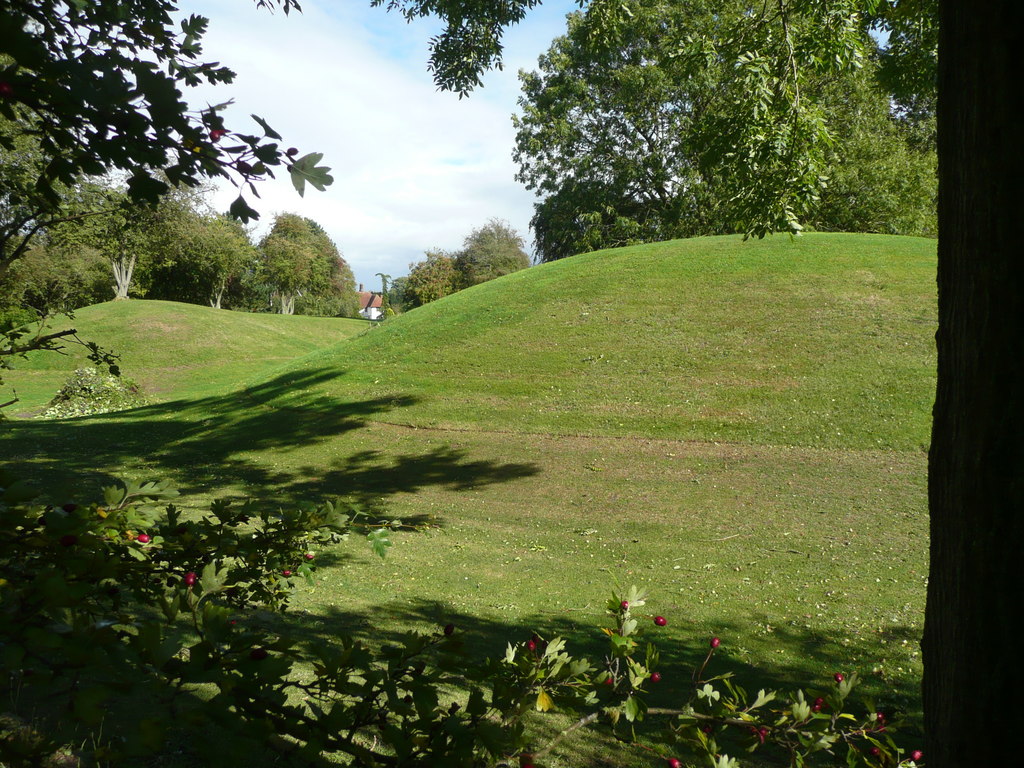
Meppershall Castle, also known locally as “the Hills”, is a medieval motte and bailey castle in the village of Meppershall, Bedfordshire, with defensive earthworks protecting what would originally have been an enclosed settlement to its east.
History
The village of Meppershall lies along a spur of land, and Meppershall Castle and the village church were built at the highest spot. The village was quite small at the time of the Norman Conquest, but the Meppershall family who held the manor and other lands in the area were probably responsible for building a castle there soon after – although it is possible that it was constructed as late as the 1130s.
Today the castle motte is c. 25 by 30 m, almost 5 m high, with two irregular shaped baileys, the outer bailey c. 50 m by 20 m, and the triangular inner bailey, c. 60 m by 40 m across, all protected by a bank and what was originally a wet moat, fed by a leat. A large square-shaped earthwork, approximately 350 m across, was constructed adjacent to the castle to the east, its bank and ditch enclosing what would have been a settlement.
In 1138, during the civil war known as the Anarchy, King Stephen moved to reoccupy the region, besieging Bedford Castle. As part of the campaign, according to chronicler accounts, Stephen probably besieged Meppershall Castle, although it possible that instead he used it as a base for the Bedford siege.
In the 21st century, only earthworks of the castle and village defences remain, which are protected under UK law as a Scheduled Monument.
Attribution
This article includes an image from the Geograph website, “Meppershall Castle”, author Humphrey Bolton, released under CC BY-SA 2.0.