
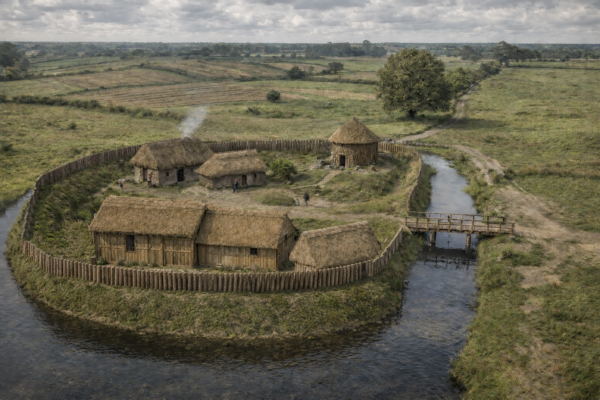
Gannock Castle was a moated, fortified medieval site in the village of Tempsford, Bedfordshire. It was not occupied for long, and only earthworks now survive.
History
Tempsford lies in the River Great Ouse valley, an area of flat, low-lying land. Its main medieval centre was in the south-west of the parish, now called Church End, and the north-east, now called Langford End. There were several manors in the area, including Tempsford manor and what later became known as Brayes manor.
In 917, chroniclers recorded that a Danish army advanced from East Anglia to Tempsford and constructed a fortress there. Later that summer, the Anglo-Saxon king Edward the Elder mobilised an army and retook Tempsford, killing the Danish king. If a fortress was constructed in Tempsford, its location is uncertain. By tradition, Gannock Castle was considered to have Danish origins, but there is no evidence to support this.
After the Norman conquest, Tempsford manor was initially held by Eudo Dapifer, and sublet to William de Carun. After Eudo’s death the manor passed to the Beauchamp family, but remained sublet to the de Carun family until the end of the 13th century. On the death of Robert de Carun, his property passed to his two daughters, and the manor of Tempsford was divided into two between them, the second half being called Draytons Manor.
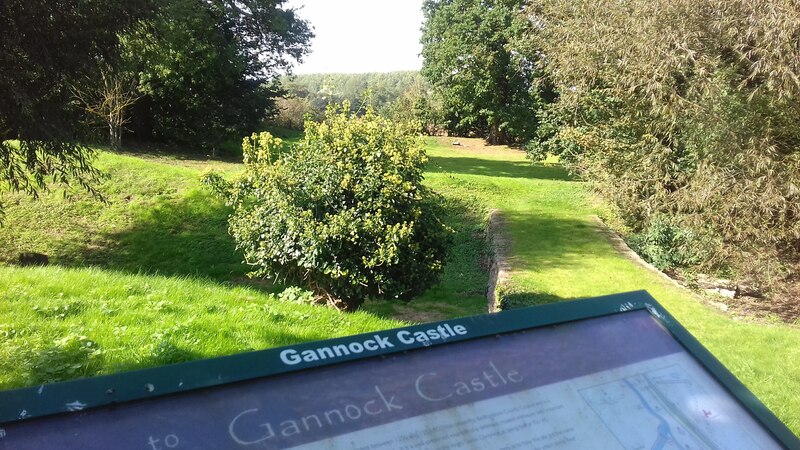
At some point during this period, Gannock Castle, just to the west of Church End, was in use. The site is a rectangular island, approximately 55 by 45 m, surrounded by a 10 m wide, 2.5 m deep moat, which would originally have been entirely water-filled. A bank and ramparts ran along the inside, and a 7 m wide mound, possibly supporting a timber tower, is on the north-east corner. Various buildings would have been inside the fortifications.
The site was probably a defended manor house, dating from the late 11th or 12th century. It is unclear how long it was occupied for, but by the late 20th century the remaining earthworks were heavily overgrown. A local organisation, the Friends of Gannock Castle, carried out clearance and restoration work after 2003, including commissioning a geophysics survey of the site. The earthworks are protected under UK law as a Schedule Monument. Another nearby fortified site, Tempsford Park manor house, was also occupied during the medieval period, although again only earthworks remain.
Bibliography
- Chapman, Andy and Anthony Maull. (2005) A Medieval Moated Enclosure in Tempsford Park. Bedford Archaeology: Bedford.
- Page, W. (ed) (1908) Victoria County History of Bedfordshire Vol. 2.
- Shotliff, D. (1996) “A moated site in Tempsford Park, Tempdford,” Bedfordshire Archaeological Journal Vol. 22. pp.96-128.
Attribution
The article includes a photograph from the Geograph website, author N Avery, and released under BY-SA 2.0.