
Tempsford Park manor house was a fortified, moated site on the north-east of Tempsford, Bedfordshire. The site was occupied since the Roman period, but in the early to mid-13th century a substantial moated manor house was constructed there. It was not used for long and by the middle of the 15th century the house had been dismantled. Only limited earthworks still survive.
History
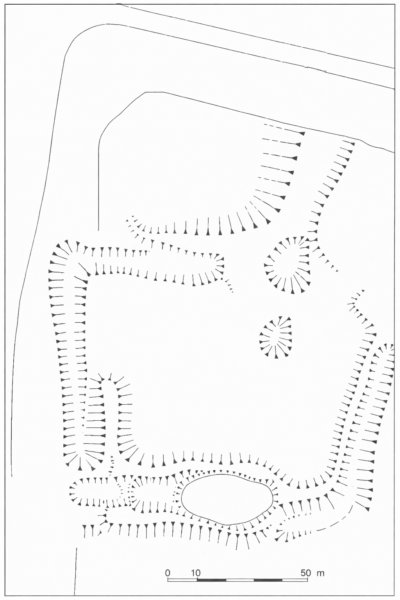
Tempsford lies in the River Great Ouse valley, an area of flat, low-lying land. Its main medieval centre was in the south-west of the parish, now called Church End, and the north-east, now called Langford End. There were several manors in the area, including Tempsford manor and what later became known as Brayes manor. The latter controlled the access between Langford End and the main ford over the Great Ouse towards the nearby settlement of Roxton.
This north-east site had been occupied since the Roman period, and during the Anglo-Saxon period it was part of a well-structured settlement. Brayes manor was recorded after the Norman Conquest of 1066 and its manor house was probably built within the site, although its precise location has not been determined. The site was certainly occupied, however, with smithing and metalworking taking place. To the south-west, Garrock Castle, a small, moated manor house, was in use near Church End.
In the late 12th or early 13th century, an aisled hall and kitchen range was built on the site. This was probably carried out by the Bretville family, who then owned the manor. Between the early to mid-13th century, the site was developed further, either by the Bretvilles or the Blundell family, who briefly held the property in the mid-13th century.
A moat was dug around the site and a substantial manor house, covering 0.65 hectares, was constructed within it. The moat was broad and flat bottomed, up to 12 m wide and 2 m deep and water filled. It was accessed from the north, either by a timber bridge or an earth causeway. The site was flat, raised slightly above the surrounding area using fill from the ditches, with a metalled yard in it centre. The T-shaped manor house was on the western side, with a parlour and solar to the north, and a service wing on the south. A kitchen, bakehouse, barn, stables, and a dovecote probably lay along the opposite side of courtyard.
There is little evidence for occupation of the moated site beyond the end of the 15th century. The manor house appears to have fallen out of use and been dismantled by the middle of the 15th century. George Keynsham brought Brayes manor, Draytons manor and Tempsford manor together between 1565 and 1566, and he probably no longer needed the manor house. The site continued to be used for livestock grazing
The moated enclosure then appears to have been left largely undisturbed until Sir Gillies Payne built Tempsford Park and Hall in the late 18th century, when the area was landscaped and a “stew” pond was dug out of the southern moat. The final recorded episode was the dumping of debris in the northern moat in the late 19th century. Maps of the period simply refer to the location as “stew ponds”, and only earthworks now survive.
Bibliography
- Chapman, Andy and Anthony Maull. (2005) A Medieval Moated Enclosure in Tempsford Park. Bedford Archaeology: Bedford.
- Page, W. (ed) (1908) Victoria County History of Bedfordshire Vol. 2.
- Shotliff, D. (1996) “A moated site in Tempsford Park, Tempdford,” Bedfordshire Archaeological Journal Vol. 22. pp.96-128.