
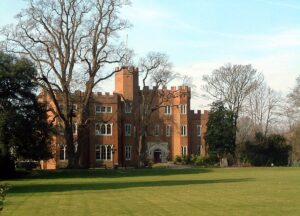
Hertford Castle was originally built in 1066 after the Norman Conquest, to control the town of Hertford, Hertfordshire. Originally a motte-and-bailey design, it was rebuilt in stone in the 1170s and converted into a secure residence in the 1380s. It fell out of use and most of the castle was pulled down under James I. The castle’s brick gatehouse, dating from the 1460s, survived and became used variously as a residence, workshop and, for a short period, a college. In 1911 the site was leased to the Hertford town authorities; the centre of the castle became a park and the gatehouse used as offices by the council.
History
Hertford Castle was built by the Sheriff of Hertfordshire, Peter de Valognes, on the orders of William the Conqueror after the Norman invasion of England in 1066, as part of a sequence of fortifications around the approaches to the city of London. Hertford was already an Anglo-Saxon burh, a defended town founded by Edward the Elder in 912. The new fortification was a motte-and-bailey castle with earthwork and timber defences, and its constable was initially the royal sheriff of the county. It was located close to the junctions of the River Lea and the River Maran, just south-west of the town. It would have enjoyed good hunting at the nearby Hertingfordbury Park.
By 1170, Henry II was facing a potential revolt in England. The King ordered the sheriff to rebuild much of the castle in stone, at considerable expense, and enhanced the earthwork defences. By the time his son, the Young Henry, rebelled in in 1173, the work had been completed and a garrison of knights and sergeants fully in place.
The First Barons’ War broke out in 1215 between Henry’s youngest son, John, and the baronial rebels. Hertford Castle was besieged by Prince Louis of France and the rebel barons in 1215. Walter de Godarville, one of the royalist leader Falkes de Breauté’s lieutenants, held out for a month, before probably running out of supplies and surrendering. The castle was held by the rebels until peace was declared the following year.
The damage done to the castle during the war was made good in 1225 at the cost of £10, and various buildings belonging to Falkes de Breauté, who had fallen out of favour with the Crown, were moved from Little Berkhampstead and rebuilt within the castle. In 1249, the role of the castle constable passed from the sheriff to the owner of the surrounding manor of Hertford, initially Henry III’s half-brother, William de Valence, the Earl of Pembroke.
The castle continued in use by the Crown and was kept well repaired. Queen Isabel was granted it in 1327 and used it as an occasional residence, dying there in 1358. Edward III detained King John of France there during the Hundred Years War, as was David, King of Scotland.
John of Gaunt, Edward’s immensely rich youngest son, was granted the castle in 1360. In 1380, John commissioned William Wintringham, who had done work for him at Kenilworth Castle, to improve the property. William redeveloped the centre of the bailey, constructing a range of buildings to form a sequence of courts – a sort of secure palace. John also developed its defences using large quantities of timber extracted from neighbouring estates, and lived there between 1396 and 1399.
Shortly after John’s death, the castle reverted to the Crown when his son Henry IV, took the throne in 1399. It was used occasionally by Henry VI during the 1420s. During the 1460s it was renovated by Edward IV, who built a new gatehouse in brick on the site of the former gatehouse between 1463 and 1465 at a cost of over £200. Henry VIII continued to use the property, as did Queen Elizabeth I.
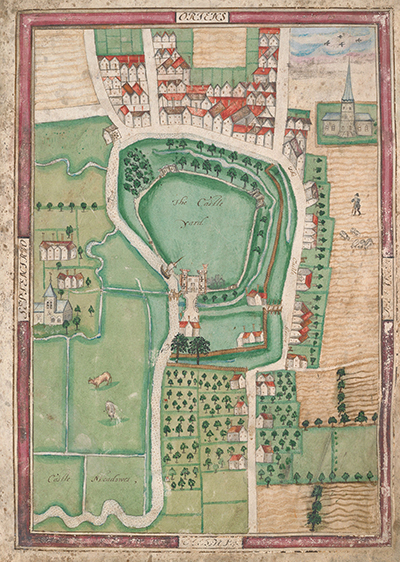
During the 14th and 15th centuries, however, Hertford’s wealth and status declined. Furthermore, by the time James I took the throne in 1603, many royal castles were falling out of use. James soon pulled down most of the buildings within Hertford Castle, filling in the moat and converting the gatehouse into a house; a survey of 1610 shows that only limited parts of the castle still remained intact, and other survey in 1621 described the site as “now decayed”.
Charles I granted the castle to his friend and adviser, William Cecil, the Earl of Salisbury, in 1628. The Earl leased it to a Sir William Harrington, followed over the years by the Cowper and Collet families. By the middle of the 18th century, the castle was being used by tradesmen and by farmers, fattening cattle for sale in London.
Between 1789 and 1792, the Marquess of Downshire, brother-in-law of the Marquess of Salisbury, redeveloped the gatehouse in a Gothick style, including building a north wing and south wing. By the late 19th century, the converted gatehouse was described by a visiting antiquarian as “a handsome modern house to look at, with pleasant gardens and grounds”. By custom, the tenant would sublet it to visiting judges at assizes.
In 1806, the gatehouse was temporarily occupied by the newly formed East India College, created by the East India Company to train clerks for colonial service. Hertfordshire had strong links to the company. Once permanent facilities were built at nearby Hertford Heath, the college left the castle which returned to private use.
By 1905, the castle ditches had largely been infilled, with houses encroaching along the former defences. In 1911, the Hertford Corporation demolished these, exposing the castle walls to public view and increasing local interest in the site. Proposals were put forward to purchase the castle and gardens as a local amenity, but the then Lord Salisbury instead offered the site up on a “peppercorn” lease, which the town authorities accepted.
Much local argument then followed around the cost of converting and maintaining the castle, and how often it should be open free of charge for the poorer members of the community. The town council eventually used existing legislation to permit it to convert the site, cutting a new entrance was cut through the castle wall, removing the existing tenant, a Mr E. Hopkins, and moving the council offices onto the site.
Between 1968 and 1971, the interior of the gatehouse was renovated, revealing much of the original 15th century design. In 1977, an archaeological investigation was made of the eastern ditches, and between 1988 and 1990 further work was carried out on the south-western side. In the 21st century, the site is protected under UK law as a Scheduled Monument, with the gatehouse is protected under UK law as a Grade II* Listed Building.
Architecture
The castle stands on low ground on the bank of the River Lea, south-west of the town of Hertford. The original castle was approximately 240 by 150 m in overall size. The keep is now 30 m in diameter and 6.5 m high, at the north end of the site, overlooking the river; it would originally have been protected by a ditch. A bailey, 120 by 100 m across, was ultimately protected by a stone curtain wall, built mainly of flint rubble and protected by an outer double ditch that linked to the river. The river provided additional defences on the north-west side. The east and south edges of the wall still survive with parts of the ditch, now 9 m in width. A further outer bailey existed on the south-west corner of the castle, which has since been lost.
On the west side, the 15th-century gatehouse was built from brick, and then altered in the 18th and 19th centuries. Today this building, with its 18th-century extension, is known as Hertford Castle. It is three storeys tall, with half-octagonal bays on each corner giving the impression of towers, but was unornamental in design, probably to reduce costs.
Bibliography
- Bryant, Stewart and Vicky Seddon. (1999) Hertford: Extensive Urban Survey Project Assessment Report. English Heritage and Hertfordshire County Council (Hertford).
- Emery, Anthony. (2000) Greater Medieval Houses of England and Wales 1300-1500, Volume II: East Anglia, Central England and Wales. Cambridge University Press: Cambridge.
- Ginn, A. P. (1912) “The Acquisition of Hertford Castle”, Transactions of the East Herts Archaeological Society Volume V, Part I.
- Grose, Francis. (1785), Antiquities of England and Wales, Volume 2. .S. Hooper: London.
- Standing, Percy Cross. (1905) Memorials of Old Hertfordshire. Bemrose and Sons: London.
Attribution
This article includes images from the Yale Centre for British Art – Survey of Hertford Castle, 1608, released as public domain; and from the Wikimedia website – “Hertford Castle“, author Caitlin, released under CC BY 2.0.
